
WATER HARVESTING
We need water for our regenerative agriculture activities; to grow vegetables for the food closets, for the fruit trees in our dry-farm orchard trials, and for the grains, potatoes and other staple crops we are testing. Unfortunately, neither our forest farm near Colfax, nor our oak woodland campus outside of Auburn are well served by local water districts.
Even in drought years however, our local lands receive significant rainfall . Our forest campus near Colfax receives almost four feet of rain in an average year, and nearly three feet in drought years. Some of this water percolates into the ground, but some runs off into local streams and eventually flows out to the ocean. We have found through research and observation that there are ways of harvesting this water for our regenerative agriculture activities.

Springs:
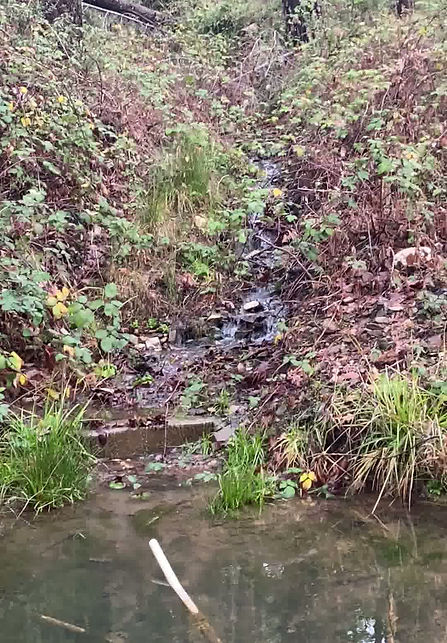
Our Colfax Campus contains numerous small springs and seeps. These are crucial for wildlife; their access to water must be preserved. But some of the springs can yield sufficient water to share, some for the animals and some for our crops. So we are working to capture the flow of these springs high in the hills and pipe it to nearby plots with good soil using only gravity. This is where we have located our irrigated gardens.
Storing water in our soil:
All soil will hold water. Barren rocky soil holds little while loamy soil rich with organic matter and life, stores considerable water. The land on our Colfax campus is blessed with many plots which contain deep, loamy soil with very high capacity to store water. Unfortunately, most of these are above our springs, and so we can't irrigate them without expensive and environmentally destructive pumps and conveyance systems. As a result, we are working to help these plots capture and store more of the rain water that falls directly on them by adding supplemental organic matter. In doing this, we are testing the concept that the combination of excellent soil and enhanced organic matter will allow us to grow fruit crops, some staple crops, and even some vegetables with little or no supplemental irrigation. Thus we are trying to revive the ancient practice of dry farming. We believe this approach to agriculture may be less costly than conventional farming, and can still grow food when climate warming degrades California's vast water infrastructure to the point where it can no longer provide sufficient water for growing food.